
Posted July 20, 2026

By Today's Tech FWD
Ozempic for Aging
Ray Blanco:
Scientists Just Reversed 40 Years of Aging
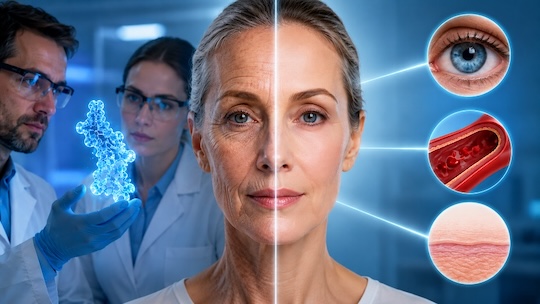
Scientists at Revel Pharmaceuticals just built an enzyme that doesn't exist in nature. It strips away a form of molecular damage called CML that welds itself onto your collagen, elastin, and arterial walls over a lifetime – driving arterial stiffness, chronic inflammation, and the cascade behind heart disease, stroke, and diabetic complications.
Since the 1980s, this damage was considered permanent. Not anymore.
Revel used Google's AlphaFold AI to screen 45,000 protein structures, then ran directed evolution across 500 million enzyme variants. The result – CMLase – reduced CML in a 75-year-old's arterial tissue by over 70%, bringing it to levels seen in a 30-year-old.
Skin came back below age 31. Eye lens proteins cleared 45–78%.
So far, this has all played out in the lab – on human tissue, not in a living body yet. Getting it into a patient is the next mountain. But the damage the whole field swore was permanent? It just came off.
You can't buy Revel – it's private. But that's how things start. A breakthrough shows up in a lab. Then capital floods in, platform companies form, and an entire category of medicine is born.
We've watched obesity peptides rewrite the pharmaceutical map. Molecular repair enzymes could be next.
 |
|---|
James Altucher:
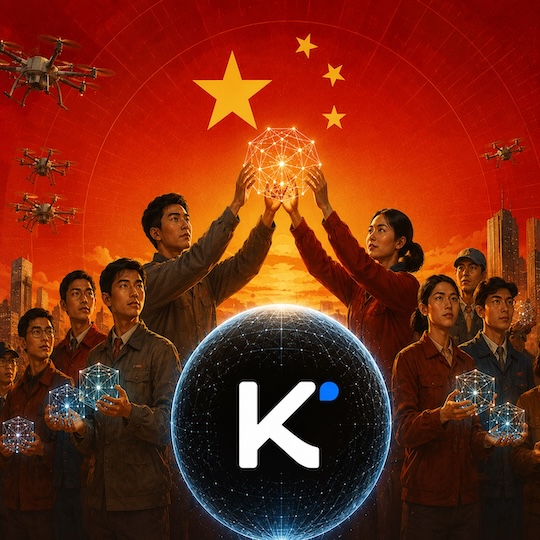
An OpenAI Exec’s Comments on China’s Kimi K3 Kicked Off a Big U.S. Tech Debate
China has embraced open-source or open-weight AI models, which allow developers to inspect and customize them, while the U.S. mostly remains closed.
A debate on the topic erupted on X over the weekend after an OpenAI executive published a reaction to Kimi K3, a recently debuted model by China's Moonshot AI. The model crushed a bunch of notable benchmarks.
"I am personally surprised the Chinese state continues to allow the open sourcing of models this good, given potential risks," Dean Ball, a former senior advisor on AI to President Donald Trump who is newly OpenAI's head of strategy, wrote on X.
He said the open-weight strategy would lead to full "AI communism" and that open models can be "decelerationist" because they "deter AI capex."
What really got the conversation going, though, was this:
"I would guess that the Trump Administration will at some point realize that their best strategy here would be to create large amounts of regulatory risk around the use of open-weight Chinese models," he wrote.
Ball later clarified that this was his prediction, not a recommendation, and that he supports open-source up until the point AI becomes too dangerous, which he said would be a "sad day."
 |
|---|
Chris Campbell:
SpaceX Reportedly In Talks To Supply Pentagon With AI Computing Power Worth Billions
Elon Musk's rocket manufacturing and AI company SpaceX (SPCX) is reportedly in talks with the Pentagon to supply billions of dollars' worth of data-center capacity for running AI models.
According to a report from the Wall Street Journal, the two sides are negotiating an arrangement under which SpaceX would provide computing capacity to the department at a cost of up to several billion dollars. Talks could collapse with no deal, people familiar with the matter said.
Amazon, Microsoft, Google, and Oracle already provide capacity to the Pentagon. The potential detail would give the United States Department of Defense more cloud-computing resources to support AI applications across the National Security Agency and warfighters.
SpaceX, meanwhile, is planning a major expansion of its cloud-computing efforts, including competing directly with providers like CoreWeave by offering its computing capacity at lower prices, the report said.
SpaceX has already signed cloud-computing deals with Anthropic, Google, and Reflection AI in recent months to rent out data-center capacity for running AI models. Combined, the three deals represent roughly $27–28 billion in annualized revenue at full rates. All contracts include flexibility clauses allowing early termination, reflecting the fast-moving AI sector.
Sign Up Today for Free!
Today’s Tech FWD compiles all the best trading tips and market insights straight from our panel of distinguished analysts, including James Altucher, Ray Blanco, Chris Campbell, Greg Guenthner, Zach Scheidt and more.
Inside each issue, you'll find perspectives from our experts about speculative ways to trade, tech trends, crypto news and the latest AI opportunities so YOU can profit while the rest of the market is left behind.
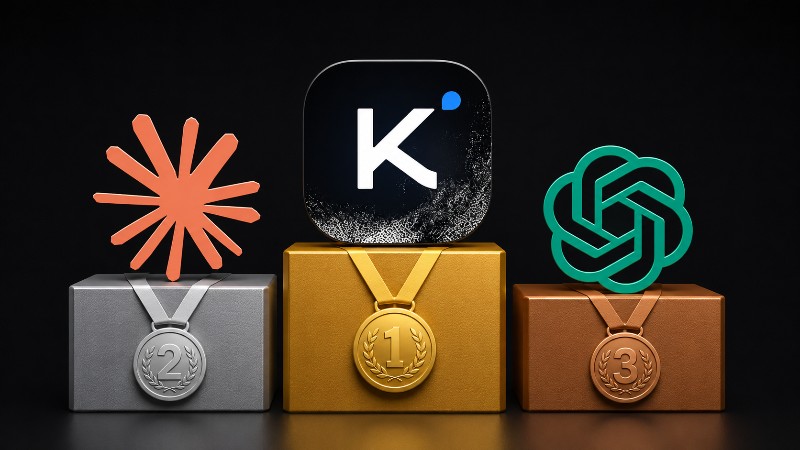
Kimi K3: DeepSeek Déjà Vu
Posted July 17, 2026
By Today's Tech FWD

The Milky Way Just Got Sweeter
Posted July 16, 2026
By Today's Tech FWD

The Sky Is Getting a Giant Mirror
Posted July 15, 2026
By Today's Tech FWD

AI's Biggest Sleeper Stock
Posted July 14, 2026
By Today's Tech FWD

The 2027 Memory Crisis
Posted July 13, 2026
By Today's Tech FWD